Request a free offer
We look forward to learning more about you and your project.
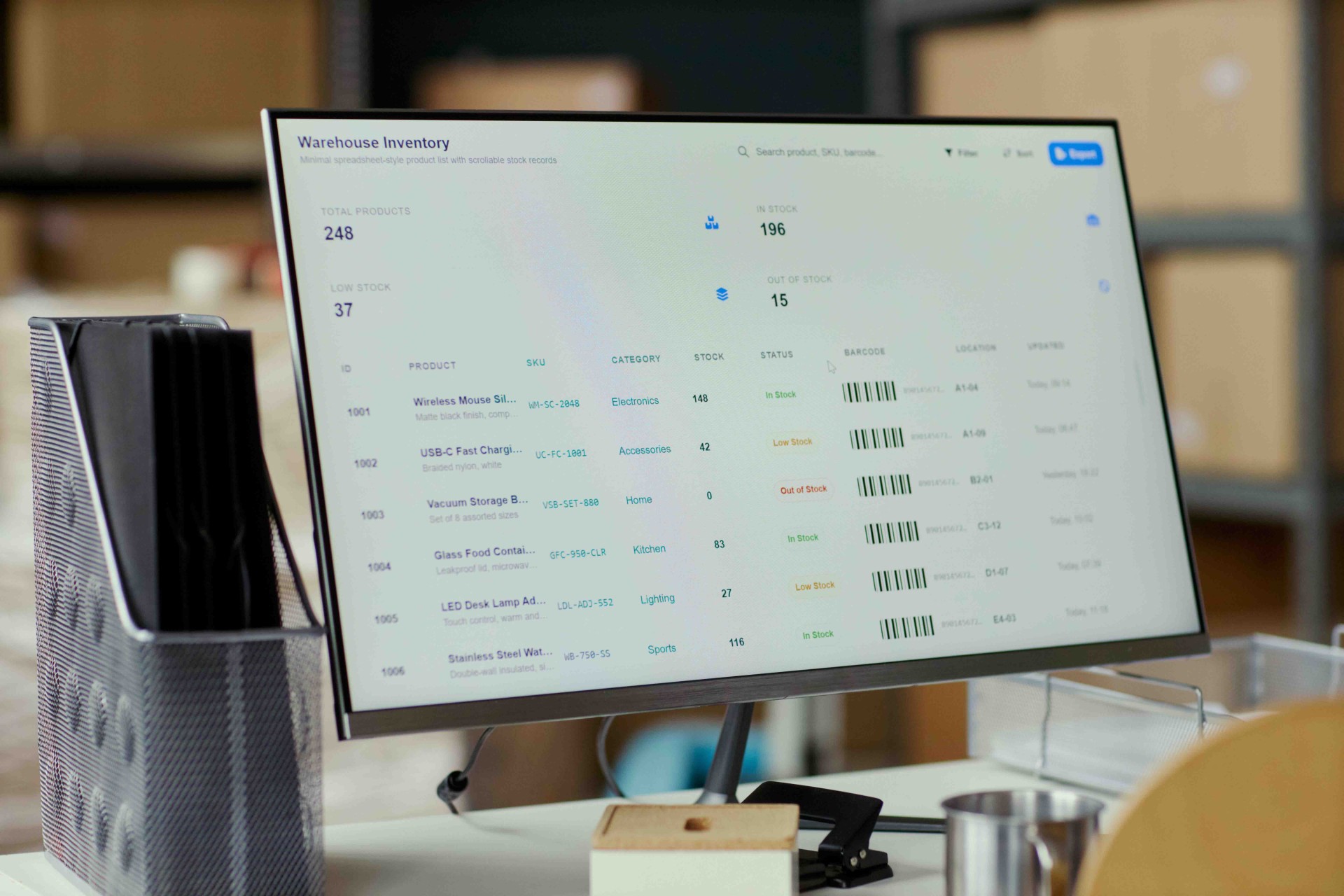
An SKU, short for Stock Keeping Unit, is an internal identifier a company uses to uniquely identify a specific variant of a product. This includes the product itself as well as attributes such as size, colour, material or packaging unit.
Each variant gets its own SKU, even when several variants are grouped under the same product name or EAN. A T-shirt available in three colours and four sizes therefore consists of twelve individual SKUs. In the warehouse, in the shop system and during picking, the SKU is the reference that uniquely addresses each of these variants.
The SKU is the central reference for every process around storage and goods movement. In the warehouse management system, every item is tracked by its SKU, from goods-in through inventory management to picking.
In e-commerce, the SKU also links several systems together: the shop, the merchandise management system and the fulfilment provider all refer to the same identifier. This prevents mix-ups between similar product variants and keeps inventory reconciliation between systems reliable.
The SKU also matters for sales reporting. Retailers can see at SKU level which variant of a product sells well and which doesn't — information that would be lost at product level alone.
Unlike the EAN, there is no binding standard for the SKU. Each company defines its own format, usually an alphanumeric code that captures several product attributes at a glance.
A common scheme combines abbreviations for category, product, colour and size — for example SH-RUN-BLK-42 for a black running shoe in size 42. How detailed this structure needs to be depends on the product range: the more variants an item has, the more important a clear, consistent scheme becomes.
What matters most is that the chosen format is used consistently across all systems. If the logic changes later, for instance because new categories are added, adjusting the existing inventory usually takes extra effort.
The three terms are often used interchangeably in everyday language, but they describe different things. The EAN (European Article Number, now part of the GTIN family) is a globally unique, standardised code that identifies a product across company boundaries, for example at a supermarket checkout.
The SKU, by contrast, is internal to the company and freely definable. Two retailers can assign completely different SKUs to the same product, while the EAN stays identical for both. The product number, finally, is usually the internal designation from the ERP system and often matches the SKU in content, though it doesn't have to.
In practice this means: the EAN governs communication with the outside world — with marketplaces or suppliers. The SKU governs control on the inside — in your own warehouse and your own systems.
A clearly structured SKU logic has a direct impact on warehouse processes. Staff picking orders find items faster, mix-ups between similar variants decrease, and sources of error in inventory management are reduced.
A clean SKU structure also makes it easier to reconcile stock across multiple sales channels. Anyone selling through an online shop, marketplaces and brick-and-mortar retail at the same time needs an identifier that works the same way across every connected system.
Finally, a well-planned SKU structure grows with the product range. New variants or categories can be slotted in without calling the existing system into question — a point that pays off once item counts start climbing.
SKU in day-to-day fulfilment
For us as a fulfilment provider, the SKU is the interface between your shop system and our warehouse. Every order placed in your shop is passed to our warehouse management system via the SKU and assigned to exactly the right variant there.
Especially for product ranges with many variants, a clean SKU setup pays off — for example in automated picking, where items are addressed directly via their SKU. When we take on a new product range, we always review the existing SKU structure and, where needed, align it together with you.
Want to know how a well-thought-out SKU structure can simplify your fulfilment? Get in touch — we'll take a look at your product range together.

We look forward to learning more about you and your project.